Featured Industrial Racking Systems
Engineered with certified high-tensile Q235B/Q355B structural steel, our heavy-duty warehouse storage rack systems are designed for extreme load capabilities, seismic resilience, and seamless integration with modern material handling equipment.
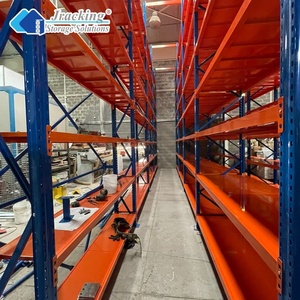
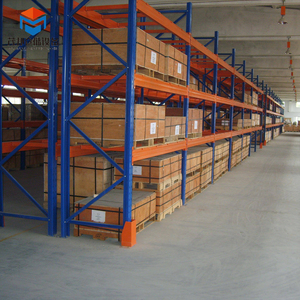
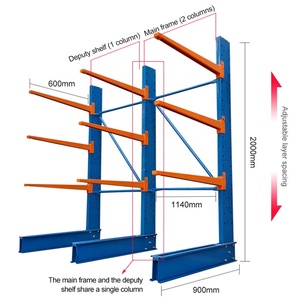
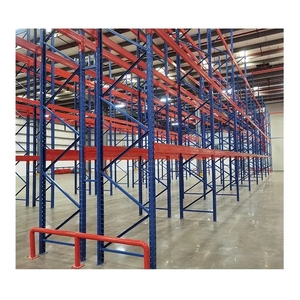
Structural Engineering & Metallurgical Superiority
As a premier industrial rack storage manufacturer and global exporter in China, our competitive edge relies on precise structural calculations, certified material traceability, and adherence to international design standards. Industrial pallet racks are not merely steel frameworks—they are crucial load-bearing assets subjected to static dead loads, dynamic forklift impacts, thermal expansion in cold storage environments, and transient seismic stress.
1. Steel Grade Selection: Q235B vs. Q355B Structural Steel
The foundation of racking integrity lies in raw material metallurgy. While standard shelving often utilizes basic commercial grade steel, heavy-duty industrial storage racks require high-yield cold-rolled structural steel profiles:
- Q235B Carbon Structural Steel: Yield strength $f_y \ge 235 \text{ MPa}$, Tensile strength $R_m$ ranging between $370\text{--}500 \text{ MPa}$. Ideal for standard selective pallet rack beams, shelf decking, and light-to-medium upright profiles requiring maximum ductility and economic feasibility.
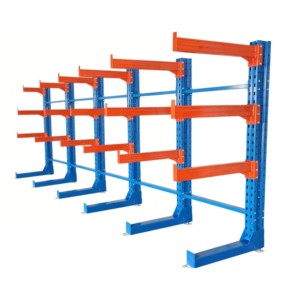
- Q355B High-Strength Low-Alloy Steel: Yield strength $f_y \ge 355 \text{ MPa}$, Tensile strength $R_m$ ranging between $470\text{--}630 \text{ MPa}$. Specified for high-bay warehouse upright frames, structural C-channel columns, and heavy cantilever arms operating under severe loading conditions or sub-zero logistics operations.
2. Surface Finishing & Corrosion Resistance Standards
To guarantee a 20+ year operational lifespan, components undergo a automated 7-stage pre-treatment wash (including degreasing, zinc-phosphate conversion coating, and DI water rinse) prior to electrostatic thermosetting epoxy-polyester powder coating.
| Performance Parameter | Standard Powder Coating | Hot-Dip Galvanized (HDG) | Testing Standard Compliance |
|---|---|---|---|
| Coating Thickness | 60 – 90 Microns ($\mu\text{m}$) | 80 – 120 Microns ($\mu\text{m}$) | ISO 2178 / ASTM B499 |
| Salt Spray Resistance | 500 Hours (No Blistering) | 1,500+ Hours (Extreme Environment) | ASTM B117 / ISO 9227 |
| Impact Resistance | 50 kg·cm (Direct Impact) | Metallurgical Bonded Alloy Layer | ASTM D2794 |
| Recommended Environment | Indoor Dry Distribution Centers | Outdoor Yards / Chemical / Cold Rooms | ISO 12944 Corrosivity Categories |
3. Global Structural Design Standards Compliance
Our engineering team performs Finite Element Analysis (FEA) modeling for every custom facility layout, validating frame buckling limits, beam deflection criteria (strictly controlled under $L/200$ to $L/300$), and floor anchor shear capacity in alignment with:
EN 15512 & FEM 10.2.02
European code governing steel static storage systems, specifying rigorous limit state design principles and safety factors for member stress.
RMI (MH16.1) Specification
United States ANSI standard for the design, testing, and utilization of industrial steel storage racks, ensuring seamless compatibility across American operations.
AS 4084-2023 Standard
Updated Australian standard for steel storage racking, mandating strict tolerances, base plate isolation, and mandatory impact risk assessments.
Future Procurement Trends in Industrial Storage
Global logistics networks are shifting from traditional static storage toward dynamic, automated, and high-density material handling ecosystems. Procuring industrial racking systems now requires long-term operational vision that aligns with automation scalability and environmental regulations.
1. AS/RS & Radio Shuttle Integration
Procurement strategies are rapidly prioritizing pallet racking structures capable of housing Automated Storage and Retrieval Systems (AS/RS), Four-Way Radio Shuttles, and Autonomous Mobile Robots (AMRs). Key metrics include millimeter-level manufacturing tolerance ($\pm 1.0\text{ mm}$) to ensure sensor alignment.
2. Green Steel & Zero-VOC Manufacturing
Enterprise buyers are enforcing strict ESG benchmarks. Overseas procurement contracts now mandate low-carbon steel sourcing (EAF electric arc furnace processing) and zero-VOC heavy-metal-free thermosetting powder finishes to reduce scope 3 emissions.
3. Modular & Standardized Component Kits
To guard against fluctuating supply chain demands, buyers favor interchangeable tear-drop and universal pitch upright designs. Modular "starter and adder" configurations reduce total cost of ownership by allowing seamless racking expansion without engineering overhauls.
Industry Development Trends: The Evolution of Chinese Racking Manufacturing
China's industrial racking manufacturing sector has transitioned from labor-intensive fabricators into high-tech, automated, precision engineering hubs. Modern smart factories utilize robotic continuous cold-roll forming lines, automated fiber laser cutting, and robotic welding cells to deliver unmatched structural consistency.
Automation in Roll-Forming & Welding Technology
Traditional punching methods introduced micro-cracks and residual stress along the column profile bends. Today, state-of-the-art continuous cold-roll forming machines integrate CNC pre-punching units that maintain exact hole pitch positioning across 12-meter single-length upright columns. Automatic multi-pass robotic welding guarantees 100% penetration along beam-to-connector joints, eliminating structural weakness points.
Rack-Supported Clad Buildings (Self-Supporting Storage)
A major macro trend in global warehouse development is the adoption of rack-supported building structures. Instead of constructing a conventional building and placing racking inside, the high-bay racking system itself serves as the structural skeleton supporting roof trusses and side cladding. This slashes civil construction schedules by up to 35% and drastically increases overall land utilization efficiency.
Why Partner With Us: Direct Manufacturer Advantages
With a manufacturing heritage dating back to 1989, our enterprise operates an expansive 530,000 sq ft modern manufacturing plant, holding over 100,000 pallet rack beams and 15,000 upright frames in standard inventory reserves. We deliver complete turn-key solutions spanning site analysis, structural engineering, custom fabrication, export container packing, and lifecycle support.
End-to-End Customization
From specialized beam lengths and non-standard upright depths to custom powder coat RAL colors, our internal engineering team tailors storage systems to match your exact floor plan, ceiling height, and forklift clearance requirements.
Export Logistics Optimization
We specialize in dense container bundling and bay-by-bay labeling. Materials are secured with heavy-duty steel strapping, corner protectors, and moisture barrier wrapping to guarantee zero shipping damage upon sea freight delivery.
Asset Lifecycle & Trade-in Services
We support complete material handling equipment lifecycles. Should your enterprise consolidate or upgrade facilities, we offer buyback programs, equipment dismantling, and trade-in allowances on undamaged structural components.
Optimize Your Storage Capacity & Request Engineering Support
Need assistance calculating load capacities, selecting appropriate upright profiles, or designing a high-density racking layout for your distribution facility? Contact our structural engineering team today to receive CAD layout designs and a comprehensive quotation.
Industrial Racking Procurement FAQ
Clear engineering and logistical answers for procurement officers, plant operations managers, and logistics planners.
How do I verify the steel grade and structural compliance of imported racking?
Every shipment from our factory is accompanied by official Mill Test Certificates (MTC) according to EN 10204 3.1 standards, detailing chemical composition (Carbon, Manganese, Silicon content) and mechanical properties (Yield strength, Tensile strength, Elongation). Additionally, third-party non-destructive testing (NDT) reports and factory audits by SGS, BV, or TÜV Rheinland can be provided upon request.
What information is required to generate a custom warehouse layout and quotation?
To provide an optimized design, our engineering team requires: (1) Warehouse floor plan drawings showing column grids, clear height, and door locations; (2) Pallet specifications including dimensions ($W \times D \times H$), maximum total weight per pallet; (3) Forklift model, maximum lift height, and minimum turning radius requirements; and (4) Site seismic zone classification.
Are Chinese rack column profiles compatible with standard US Teardrop or European systems?
Yes. We manufacture both fully interchangeable US Teardrop pitch (2-inch center adjustment) upright frames, as well as European standard 75mm and 50mm pitch adjustable systems. This allows our components to integrate seamlessly into existing warehouse racking infrastructure across North America, Europe, Australia, and Latin America.
How do you ensure proper anti-seismic anchoring and load stability?
Seismic rack design involves enlarged base plate surface areas, dual heavy-duty expansion wedge anchors per column, structural row spacers, and dynamic bracing configurations (Pratt or Warren trusses). Structural dynamic calculations ensure that racking systems remain stable under localized ground motion without structural collapse.
What are the typical lead times for manufacturing and international ocean freight shipping?
Standard manufacturing lead times range from 14 to 25 days depending on total tonnage and custom powder coating requirements. Express ocean freight routes from major sea ports (Shanghai, Ningbo, Qingdao) take approximately 14–20 days to US West Coast ports, 28–35 days to US East Coast, 25–30 days to main European ports, and 20–30 days to Latin American destinations.
Should we select Selective Pallet Racking or High-Density Storage (Drive-In, Pushback, Radio Shuttle)?
Selection depends on SKU diversity and desired throughput speed. Selective Racking offers 100% immediate access to every pallet but lower floor area utilization (~35-40%). Drive-In or Pushback Racking increases floor utilization up to 60-75% for high-volume, low-SKU operations. Radio Shuttle Systems offer maximum density and automated throughput, ideal for cold storage where energy cost per cubic meter is high.