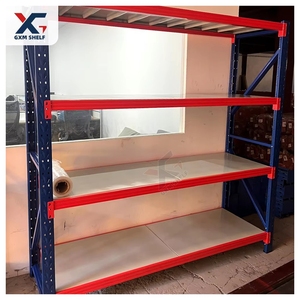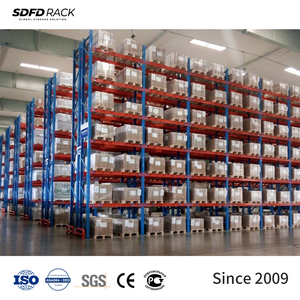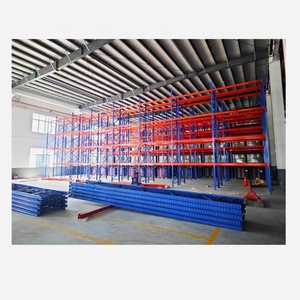
Heavy Duty Warehouse Storage Rack Pallet Racking System Customized Design for Industrial Warehouse
- Load Capacity: 1000kg - 4500kg / Beam Level
- Upright Profile: 80mm - 140mm Cold-Formed Steel
- Finish: Electrostatic Powder Coating (60-90μ)
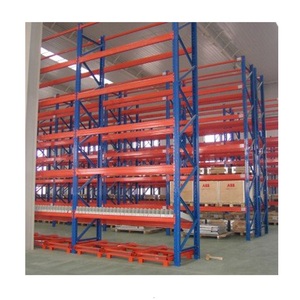
Engineered for maximal load-bearing resilience, optimized forklift access, and high-bay vertical space utilization across commercial distribution hubs.
As global supply chains expand and demand faster inventory turnaround, selecting the right industrial racking manufacturer is a critical capital expenditure (CapEx) decision. Chinese warehouse rack manufacturers have evolved from low-cost fabricators into high-precision structural engineering hubs. Backed by state-of-the-art continuous roll-forming mills, robotic fiber-laser welding systems, and fully integrated metallurgical supply chains, top Chinese manufacturers deliver structural storage systems that strictly comply with international standards such as ANSI/RMI MH16.1 (USA), FEM 10.2.02 (Europe), and AS4084-2012 (Australia).
Unlike secondary fabricators using recycled structural channels, top-tier Chinese racking exporters utilize prime cold-rolled Q235B and Q355B structural steel coils sourced directly from Tier-1 state mills like BaoSteel and Shougang. Q355B steel offers a minimum yield strength of 355 MPa and tensile strength up to 630 MPa, enabling slimmer profile wall thicknesses while raising beam frame load thresholds by up to 28% without structural sagging.
Over 24 automated continuous multi-station cold roll-forming lines guarantee rigid dimensional tolerances (±0.5mm frame straightness per 10 meters), preventing torsional twisting under heavy loads.
Full-penetration automated laser-welding arms connect beam end-connectors to box beams. 100% non-destructive ultrasonic defect testing guarantees zero micro-cracking at high-stress joint interfaces.
Automatic 9-stage pre-treatment (washing, degreasing, phosphating) coupled with thermosetting epoxy-polyester powder coating (60-90 microns thick) withstands over 1000 hours of continuous salt spray testing.
Safety in high-bay automated warehouses requires thorough engineering checks. Leading Chinese exporters apply Advanced Finite Element Analysis (FEA) to simulate real-world physical stresses. FEA modeling verifies localized buckling dynamics, sway displacement under second-order P-Delta effects, and dynamic seismic response spectrum values (simulating Zone 4 earthquake accelerations).
The global logistics landscape is undergoing a massive paradigm shift. Traditional static selective pallet storage is rapidly integrating with intelligent automation, cold-chain sustainability, and green manufacturing protocols. Procurement directors sourcing from China must evaluate how today's equipment purchases will interface with tomorrow's automated Material Handling Equipment (MHE).
Transition from manual forklift storage to Automated Storage and Retrieval Systems (ASRS) and 4-Way Radio Shuttle racking. Racking tolerance requirements tighten from standard ±3mm down to sub-millimeter precision to ensure flawless optical sensor readings for autonomous robotic shuttles.
Global procurement teams prioritize Total Cost of Ownership (TCO) over initial purchase price. Modular interlocking racking layouts allow easy teardown, re-configuration, and bay additions without discarding existing upright frames, reducing long-term expansion costs by up to 40%.
With global frozen food and biopharmaceutical demand surging, specialized cold-storage racking utilizes low-temperature structural steel alloys that resist hydrogen embrittlement at temperatures down to -30°C, combined with heavy-duty hot-dip galvanizing (HDG) for moisture barrier protection.
Select the optimal storage architecture tailored to your SKU density, picking speed, and capital investment requirements:
| Racking Architecture | Storage Density | SKU Selectivity | Forklift Aisle Requirement | Relative Cost / Pallet Position | Primary Industrial Application |
|---|---|---|---|---|---|
| Selective Pallet Racking | Moderate (40-50%) | 100% Direct Access | 3.0m - 3.8m Standard Aisle | Base Standard ($) | General Logistics, E-Commerce, FMCG |
| Very Narrow Aisle (VNA) | High (65-75%) | 100% Direct Access | 1.6m - 1.9m Narrow Aisle | Moderate ($$) | High-Bay Distribution, Pharmaceuticals |
| Drive-In / Drive-Thru | Very High (75-85%) | Low (LIFO / FIFO Lanes) | Drive-In Clearance Lanes | Cost Efficient ($) | Cold Storage, Beverage, Seasonal Bulk |
| Pushback / Gravity Flow | High (70-80%) | Moderate (2-6 Pallets Deep) | 3.0m Standard Aisle | Premium ($$$) | High Turnaround Food & Beverage |
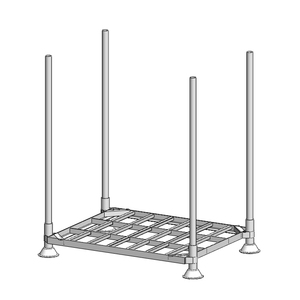
| Stackable Post Pallets (Manuracks) | Flexible Density | Bulk Stack Dependent | Dynamic Floor Layout | Low Investment ($) | Textile Rolls, Automotive Parts, Tires |
| Automated ASRS / Shuttle Racking | Maximum (85-95%) | 100% Automated System Access | Zero Forklift Aisle (Robotic) | High CapEx ($$$$) | Fully Automated Smart Warehouses |
Navigating international engineering standards, structural steel specifications, and customs clearance protocols requires clear technical clarity. Below are expert answers to common questions asked by supply chain executives and plant managers when sourcing pallet racking systems from China.
Chinese structural steel standards align closely with international metallurgical equivalents:
All raw steel coils undergo chemical composition testing (Carbon, Manganese, Silicon content) and mechanical tensile testing before processing.
Top Chinese racking manufacturers provide comprehensive quality and engineering documentation packages to support local permitting and customs clearance:
Export packaging uses multi-layer industrial protection designed for sea container shipments:
Yes. Manufacturers produce cross-compatible profile punchings. Teardrop punching (2-inch center pitch adjustment) matches standard US teardrop styles, allowing seamless interchanging of beams and uprights with existing warehouse installations. European profile options include 50mm, 75mm, and 76.2mm pitch punchings compatible with Dexion, Stow, and Speedlock systems.
VNA racking systems reaching heights over 10 meters require precise slab flatness to avoid top-of-mast sway in turret trucks. According to TR34 (4th Edition) standards, floors should meet Superflat or Category 1 (Defined Movement) specs. If slab variations exceed tolerances, manufacturers recommend installing continuous ground rail guidance or induction wire guidance systems along with precision shimming under upright baseplates.
Standard lead times for custom-manufactured pallet racking orders (1 to 10 container loads) typically range from 15 to 25 working days upon approval of final CAD layout drawings.
The workflow includes: (1) Initial CAD layout approval & structural load calculation check → (2) Raw steel coil slit-cutting & continuous roll-forming → (3) Automated laser punching & robotic welding → (4) Surface pre-treatment & electrostatic powder coating → (5) Quality Control inspection & bundling → (6) Container packing & port delivery to major Chinese departure ports (Ningbo, Shanghai, Qingdao, Shenzhen).
Maintaining structural integrity over decades of continuous operation requires proactive inspection protocols. Under EN 15635 guidelines ("Application and Maintenance of Storage Equipment"), warehouse managers must enforce weekly visual checks alongside annual expert structural audits to prevent catastrophic rack collapses.
Deformations in upright columns or bracing caused by forklift collisions are categorized into three risk levels:
Investing in heavy-duty structural accessories drastically lowers ongoing maintenance overhead and extends total operational life: