CE Certified Heavy-Duty Racking & Industrial Shelving Systems
Engineered with Q235B/Q355B structural steel, high-precision roll-forming profile geometry, and rigid quality testing to meet strict European and International warehouse standards.
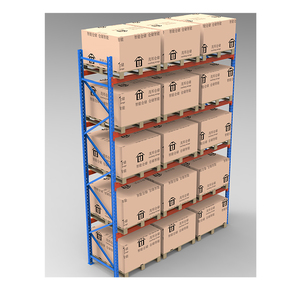
Standard Adjustable Pallet Racking Heavy Duty Steel Shelving Certificated Warehouse Racking System
Engineered for 100% selective pallet accessibility, featuring 50mm/75mm adjustable beam pitches, automatic safety locking pins, and high structural rigidity for high-bay logistics.
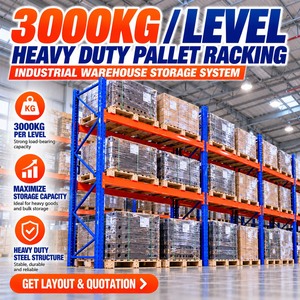
3000kg Per Level Heavy Duty Warehouse Pallet Racking System
Designed specifically for extreme industrial loads, utilizing reinforced box-beam cross-sections and heavy upright column sections to prevent torsional beam twisting under maximum stress.
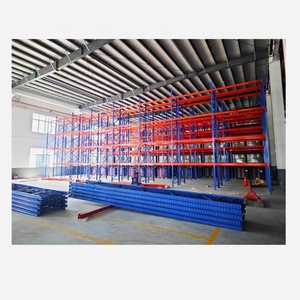
Heavy Duty Warehouse Storage Rack Pallet Racking System Customized Design for Industrial Warehouse
Tailored spatial engineering for non-standard pallet geometries, complex floor footprints, cold storage rooms, and integrated pick-module designs.
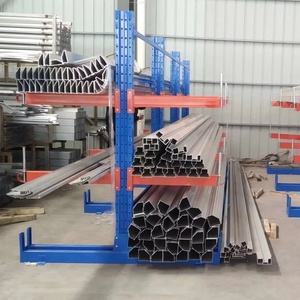
Heavy Duty Industrial Cantilever Racking System Steel Warehouse Shelves for Storage Durable for Warehouses Industrial Settings
Unobstructed front column layout optimized for storing steel pipes, timber, aluminum extrusions, and bulky linear stock. Features adjustable free-pivoting arm connections.
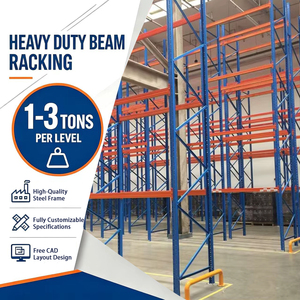
Q235 Steel Pallet Racking System Adjustable Layer Forklift Direct Access Warehouse Storage Frame for Pallet Cargo
High-grade Q235 cold-formed structural steel frame engineered for seamless reach-truck and counterbalanced forklift access with optimized entry clearances.
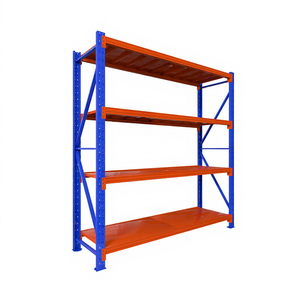
Racking Adjustable Metal Boltless Shelf and Racks Warehouse Storage Medium Duty Metal Rack Shelf
Fast assembly boltless clip connection architecture designed for manual carton picking, e-commerce fulfillment centers, and versatile spare parts storage.
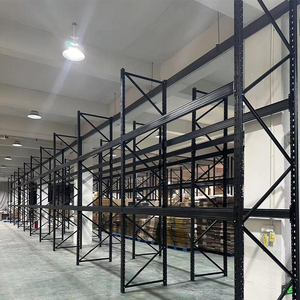
Wire Mesh Deck Pallet Racking Corrosion Resistant Dust Leakage Prevention 5-Layer Heavy Duty Warehouse Storage
Heavy-gauge welded wire mesh decking panels that enhance ESFR overhead sprinkler water penetration, eliminate dust buildup, and prevent accidental pallet fall-through.
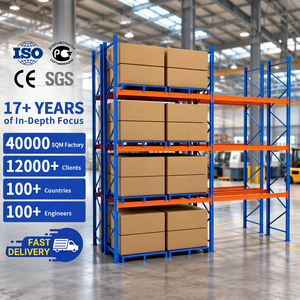
Heavy Duty Industrial Pallet Rack High Loading Multi-Level Metal Shelves Units Warehouse Steel Selective Pallet Racking System
Multi-tier high-bay racking matrix designed for maximum vertical cube utilization. Features dynamic frame bracing profiles and heavy-duty floor baseplate anchors.
The Strategic Procurement Benchmark for CE Certified Industrial Pallet Racking
An authoritative analysis of load-bearing steel metallurgy, compliance certification standards, and seismic structural safety in modern logistics infrastructure.
1. Metallurgical Foundations and Structural Engineering Integrity
In global industrial procurement, the structural performance of heavy-duty pallet racking systems is governed primarily by raw material grade selection, cross-sectional geometry, and mechanical manufacturing tolerances. Leading CE certified pallet rack shelving factories utilize premium cold-rolled coil steels, notably Q235B and Q355B (equivalent to European S235JR and S355JR under EN 10025 standards).
The fundamental differentiation between standard commercial steel shelving and heavy-duty industrial pallet racking lies in the yield strength ($\sigma_y$) and ultimate tensile strength ($\sigma_u$). Q355B steel yields a minimum threshold of 355 MPa, allowing structural engineers to optimize profile wall thicknesses without sacrificing load capacity. By executing continuous automated cold roll-forming processes, upright columns are configured with multi-rib profile shapes (typically 11 to 13 bends per post cross-section), drastically increasing the moment of inertia ($I$) and radius of gyration ($r$), thereby mitigating bucking risk under elastic axial loading.
Technical Insight for Engineering Procurement: Beam connection performance depends heavily on end-connector lug mechanics. Premium CE certified systems utilize 3-claw or 4-claw cold-stamped connectors welded with robotic metal active gas (MAG) processes, preventing joint rotation and maintaining structural frame rigidity under dynamic forklift loading.
Technical Specification Matrix: Industrial Storage Racking Comparison
| Racking Architecture | Primary Material | Load Capacity (Per Level) | Max System Height | Compliance Standards | Optimal Use Case |
|---|---|---|---|---|---|
| Selective Pallet Racking | Q235B / Q355B Cold Rolled Steel | 1,000 kg – 4,500 kg | Up to 15 Meters | EN 15512, FEM 10.2.02, CE | High SKU diversity, 100% direct access pallet picking |
| Structural Steel Racking | Hot-Rolled Structural Channels (C-Channel) | up to 6,000 kg | Up to 18 Meters | RMI ANSI MH16.1, AISC, CE | Heavy industrial, freezer rooms, high forklift impact zones |
| Drive-In / Drive-Thru Racks | Q235B Heavy Formed Section | 1,000 kg – 2,000 kg | Up to 12 Meters | EN 15512, FEM 10.2.07 | High-density bulk storage, low SKU count (LIFO/FIFO) |
| Cantilever Racks | Hot-Rolled / Cold-Formed H-Beam | 500 kg – 2,500 kg / arm | Up to 9 Meters | FEM 10.2.09, CE Standard | Pipes, timber, metal profiles, long irregular bundles |
| Pushback / Gravity Flow Racks | Q235B Frame + Nested Carts / Rollers | 1,000 kg – 1,500 kg | Up to 8 Meters | EN 15512, ISO 9001 | Medium-density dynamic inventory, multi-pallet deep lanes |
2. Certification Decoding: Why CE & EN 15512 Matter for Global Wholesalers
When international enterprise buyers source industrial shelving from global factories, verifying compliance goes far beyond checking a basic ISO certificate. CE certification under the Construction Products Regulation (CPR 305/2011) or the Machinery Directive (for automated systems) serves as a mandatory legal passport for European Union deployment and a benchmark of quality in North America, the Middle East, and Latin America.
The modern standard governing steel static storage systems in Europe is EN 15512:2019. This standard dictates rigorous structural testing methods, including:
- Stub Column Tests: Determining the real short-column compressive capacity of upright sections without relying purely on theoretical yield math.
- Bending Tests on Column Sections: Evaluating local plastic buckling behavior under combined bending and axial forces.
- Beam End-Connector Shear & Moment Tests: Quantifying rotational stiffness ($k_b$) and ultimate failure torque under asymmetric pallet loading.
- Baseplate Floor Anchor Shear Testing: Ensuring anchor bolts withstand overturning moments caused by wind load (outdoor storage) or seismic ground acceleration.
Future Procurement Trends in Industrial Pallet Racking (2025–2030)
Strategic foresights for warehouse directors, supply chain executives, and industrial equipment wholesalers preparing for next-generation material handling requirements.
1. AS/RS Compatibility & High-Tolerance Fabrication
As fully automated logistics centers and Automated Storage and Retrieval Systems (AS/RS) replace traditional manual forklift handling, rack manufacturing tolerances must shrink dramatically. Future procurement specs demand beam deflection limits tighter than standard Class 400 requirements (often restricting deflection to below L/300 or L/400). Modern CE certified factories are investing in robotic laser-cutting lines and continuous inline automated optical inspection (AOI) to guarantee sub-millimeter hole pitch consistency across 12-meter upright runs.
2. Decarbonized Steel Sourcing & Low-VOC Coatings
Global ESG mandates are driving enterprise buyers to audit the carbon intensity of structural steel products. Supply chains are migrating toward green steel suppliers utilizing Electric Arc Furnace (EAF) technology fed with recycled scrap metal rather than traditional blast furnace iron ore production. Furthermore, surface finishing tech has transitioned to 100% heavy-metal-free, low-VOC electrostatic powder coatings with closed-loop water recovery systems during pre-treatment phosphate washing.
3. Digital Twin & Sensor-Embedded Smart Racking
Next-generation warehousing introduces structural health monitoring (SHM) embedded directly into heavy-duty storage racks. Micro-strain sensors and wireless IoT accelerometers attached to critical upright columns detect forklift impact forces, structural over-deflection, and micro-seismic shifts in real time. Procurement contracts increasingly specify pre-drilled wiring pathways and sensor mounting brackets on standard upright profiles.
4. Advanced Seismic Resilience Engineering
With logistics hubs expanding in earthquake-prone coastal zones across Central America, South America, and the Pacific Rim, rack specifications now routinely require dynamic finite element analysis (FEA). Standard factory offerings must integrate oversized baseplates, heavy-duty floor anchor bolts, and dual-direction horizontal-to-diagonal bracing patterns designed to absorb kinetic energy under severe lateral ground acceleration.
Factory-Direct Wholesale Strength & Engineering Capacity
Backed by over three decades of material handling engineering, our integrated manufacturing hub combines state-of-the-art cold roll-forming lines, automated robotic welding cells, and comprehensive physical testing laboratories. We deliver complete structural design, OEM/ODM customization, and worldwide port-to-warehouse container shipping.
Technical Development Trends in Industrial Steel Shelving
Exploring breakthroughs in material science, surface passivations, and modular interlocking structural designs.
High-Strength Low-Alloy (HSLA) Steels
The material roadmap for high-bay racking systems is shifting toward micro-alloyed steels containing trace vanadium or titanium elements. These alloys achieve higher yield points (up to 420–460 MPa) while retaining ductility and weldability, allowing slimmer profiles to carry greater payloads while reducing raw material transport weight.
Modular Boltless Interlocking Geometry
To drastically reduce onsite labor costs during warehouse installation, modern shelving architectures feature precision-engineered boltless interlocking connectors. Snap-fit beam lugs and tool-free locking pins shorten assembly time by up to 40% compared to traditional bolted channel frames while retaining high moment resistance.
Advanced Anti-Corrosion Surface Finishing
Cold-chain facilities, pharmaceutical cleanrooms, and coastal warehouses demand enhanced protection against moisture and chemical degradation. Industrial development has introduced hot-dip galvanizing with zinc-aluminum-magnesium (ZAM) coatings, yielding up to 5 times greater salt-spray corrosion resistance than traditional powder coating.
Frequently Asked Questions by International Buyers & Engineers
Direct technical guidance covering structural safety, factory auditing, load testing, and container logistics.
What documentation is required to verify genuine CE Certification for pallet racking?
A legitimate CE certificate must be issued by an accredited European Notified Body (NB) under EN 15512 or EN 1090-1 standards. Buyers should request the factory's Declaration of Performance (DoP), Factory Production Control (FPC) audit reports, and full mechanical destructive load testing certificates verifying beam and column capacities.
How do European EN 15512 standards compare to American RMI standards?
Both EN 15512 and RMI (Rack Manufacturers Institute ANSI MH16.1) mandate rigorous limit-state design principles for steel structures. However, EN 15512 incorporates mandatory physical stub-column testing and precise rotational stiffness calculations for beam-end connectors, whereas RMI relies heavily on AISI cold-formed steel design specifications supplemented by load testing.
What is the maximum acceptable beam deflection limit under full load?
Under EN 15512 guidelines, the maximum allowable vertical deflection ($\delta$) of a load beam under its rated safe working load (SWL) must not exceed L/200 (where L is the clear span length of the beam). For automated AS/RS or high-precision VNA systems, deflection limits are restricted to L/300 or L/400 to prevent automated crane sensor misalignments.
Which pallet rack frame depth should be specified for standard Euro vs. US pallets?
For standard US pallets (48" D × 40" W / 1,219 mm × 1,016 mm), a 42-inch (1,067 mm) frame depth is ideal, yielding a 3-inch pallet overhang front and back. For standard Euro pallets (1,200 mm D × 800 mm W / EUR 1), a 1,000 mm frame depth provides the recommended 100 mm overhang for secure beam placement.
How do factory suppliers optimize ocean container packing for heavy steel racking?
High-volume factory wholesalers maximize 40ft High Cube (40HC) container payloads by nesting upright frames, bundling beams with heavy-duty steel strapping, and utilizing custom timber saddles. Component packaging is engineered to achieve both weight limits (up to 26,500 kg per container) and volumetric fill rates exceeding 95%.
Can customized powder coating colors be produced for corporate branding?
Yes. Industrial racking factories supply custom RAL color matching (such as RAL 5015 Blue for upright frames and RAL 2004 Orange for beams) using automated electrostatic powder coating lines. Salt-spray resistance can be customized from 240 hours up to 1,000 hours based on environmental requirements.
Accelerate Your Warehouse Procurement Plan Today
Access technical CAD engineering layouts, factory-direct wholesale pricing, and full EN 15512 CE compliance documentation tailored to your facility.